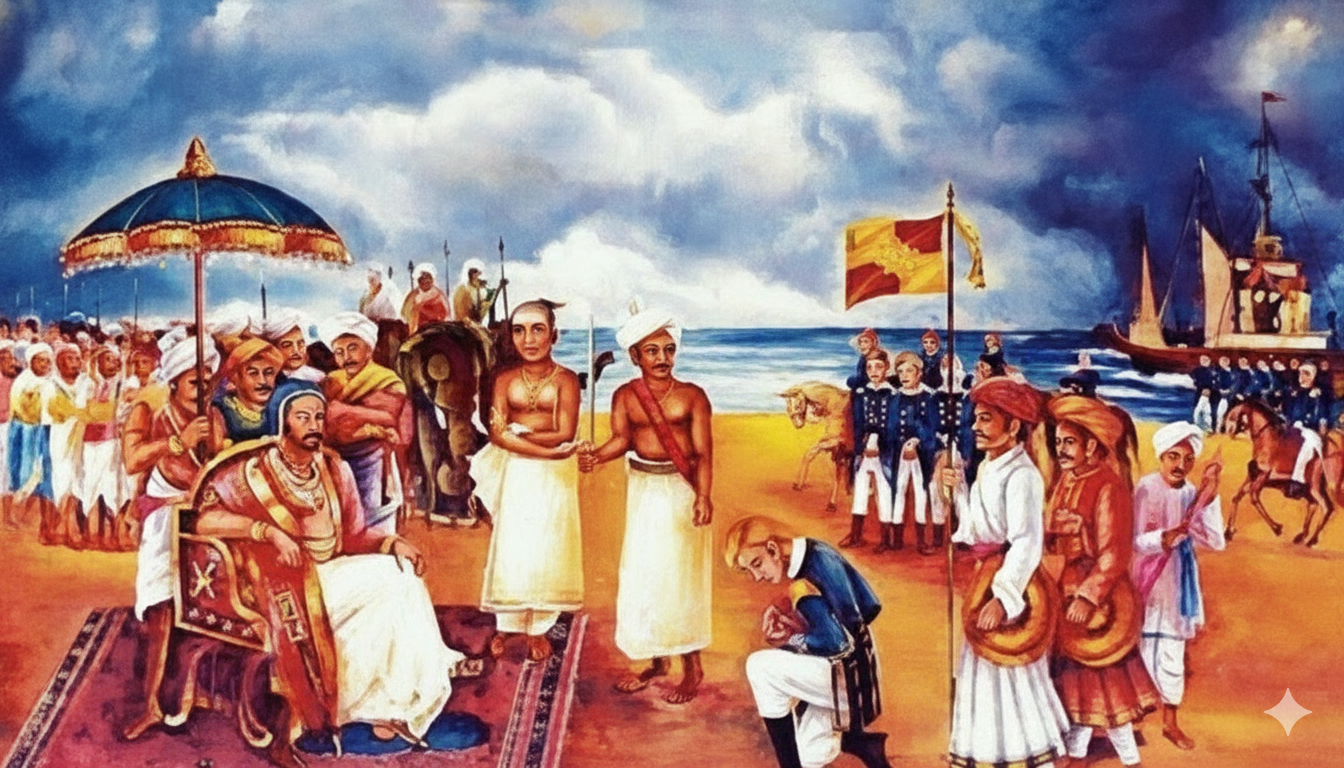
The region where the modern Indian state of Kerala exists today was once home to the powerful kingdom of Travancore. After the decline of the Chera Kingdom, several smaller principalities emerged in the region. One of these was the principality of Venad.

Marthanda Varma ascended the throne of Venad in 1729. Through military campaigns and administrative reforms, he expanded his territory and established the kingdom of Travancore. Marthanda Varma proved to be a capable and visionary ruler. One of his greatest achievements was the defeat of the Dutch East India Company in the Battle of Colachel. This victory was remarkable because it was one of the rare occasions when an Indian ruler decisively defeated a European colonial power.
In 1750, Marthanda Varma dedicated his kingdom to Lord Padmanabha and declared himself the servant or regent of the deity. This act symbolically placed the kingdom under the protection of the deity of the Padmanabhaswamy Temple. The rulers of Travancore thereafter governed as servants of Lord Padmanabha, a tradition that continued for generations.
However, Travancore later faced threats from the expanding power of the Kingdom of Mysore under Hyder Ali and his son Tipu Sultan. In order to secure protection against these threats, Travancore entered into a treaty with the East India Company in 1795. Under this arrangement, British troops were stationed in Travancore for its defense, and the kingdom had to pay a large subsidy to maintain these forces. As a result, the independence of Travancore was significantly reduced.
Over time, the demands and interference of the East India Company increased. This led to a rebellion led by the Diwan of Travancore, Velu Thampi Dalawa, in 1809. Velu Thampi issued the famous Kundara Proclamation, calling upon the people to unite and resist foreign domination. A memorial commemorating this proclamation exists today at Kundara.
The rebellion was eventually suppressed by the East India Company. To avoid capture, Velu Thampi committed suicide. Subsequently, another treaty was concluded in 1811, which further curtailed the autonomy of Travancore.
One distinctive feature of Travancore’s political system was its matrilineal succession. Although the ruler was male, succession to the throne followed the maternal line. Instead of the king’s own son, the throne was usually inherited by his nephew through his sister, reflecting the matrilineal tradition prevalent in parts of Kerala.