
The Subsidiary Alliance and the Doctrine of Lapse were two important instruments used by the East India Company to expand its imperial control in India. While some regions such as Bengal and Punjab were annexed directly through conquest, the Company subordinated many other states through the system of subsidiary alliances.
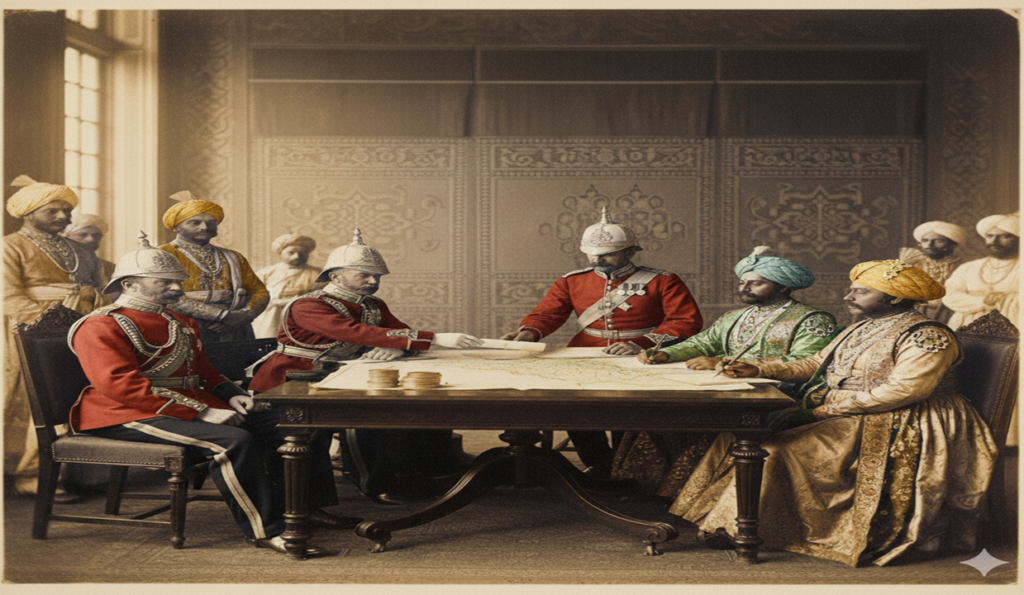
The policy of Subsidiary Alliance was primarily developed by Richard Wellesley, who served as Governor-General from 1798 to 1805. Under this system, a princely state was not formally annexed but was brought under the control of the East India Company in key matters. A contingent of the Company’s army was stationed within the territory of the allied state. The maintenance of this army was not free; the allied ruler had to pay a substantial subsidy for its upkeep. Many states such as Awadh, Mysore, and Carnatic found it difficult to bear this financial burden and were compelled to cede territory to the Company in lieu of payment.
Under the subsidiary alliance system, a British Resident was stationed at the court of the allied ruler. The state lost control over its foreign policy and could not declare war or enter into treaties without the permission of the East India Company. Consequently, the allied states gradually became politically and militarily dependent on the Company. Richard Wellesley concluded subsidiary alliances with several important states, including Hyderabad, Mysore, Awadh, the Peshwa, as well as the Maratha chiefs Daulat Rao Scindia and Yashwantrao Holkar. Subsequent Governor-Generals extended this policy to regions such as Rajputana and Kathiawar.
Another important instrument of British expansion was the Doctrine of Lapse, introduced by Lord Dalhousie, who governed India from 1848 to 1856. Dalhousie moved beyond the policy of subsidiary alliances and pursued direct annexation of Indian states. For example, he annexed Punjab after the Second Anglo-Sikh War and annexed Awadh on the ground of alleged misgovernance.
Dalhousie also formulated the Doctrine of Lapse, according to which if a ruler of a princely state died without a natural male heir, the state would be annexed by the East India Company. The British authorities refused to recognize adopted sons as legitimate successors. Using this policy, several states were annexed, including Satara, Jaitpur, Sambalpur, Jhansi, and Nagpur.
The policy of aggressive annexation contributed to widespread resentment and was one of the causes of the Indian Rebellion of 1857. After the suppression of the revolt, the administration of India was transferred from the East India Company to the British Crown in 1858, and the policy of annexation was largely abandoned.
By the time India became independent in 1947, more than 500 princely states existed, many of which had earlier entered into subsidiary alliances with the British. These states had limited military capacity and were heavily dependent on British protection. When British rule ended, they lacked the ability to resist integration into the new Indian Union. This was one of the factors that enabled Vallabhbhai Patel to successfully integrate most of the princely states into independent India.