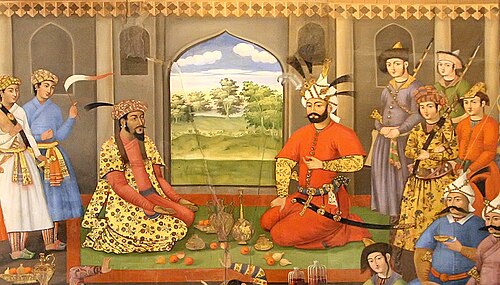
Humayun suffered severe defeats at the hands of Sher Shah Suri in the Battles of Chausa (1539) and Kannauj (1540). These losses forced him to flee successively from Agra to Delhi, then to Amarkot and Sind, before finally seeking refuge at the court of Shah Tamasp of Persia (modern-day Iran).
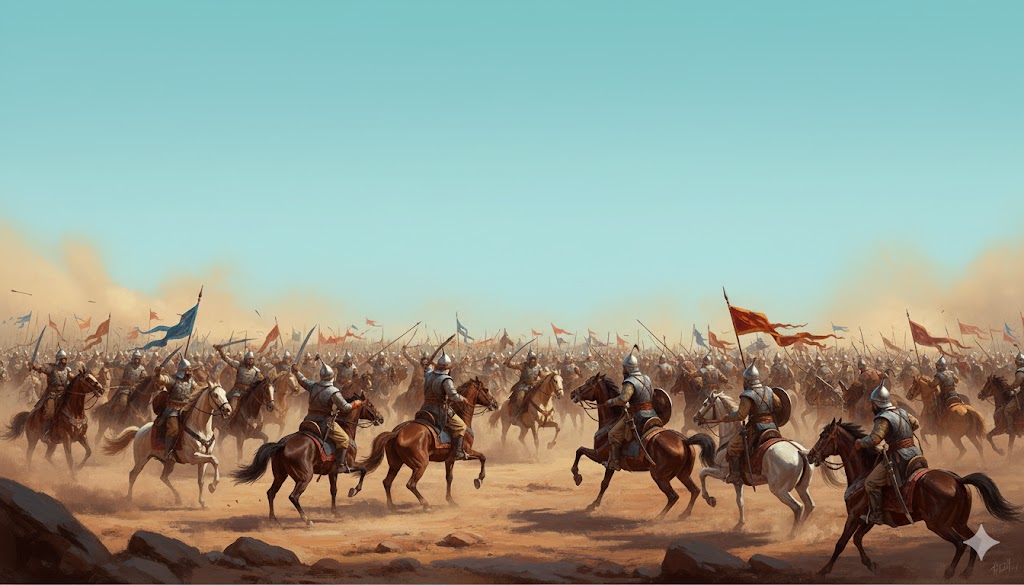
Although Humayun lost the throne of Delhi in 1540, it is remarkable that he managed to regain it in 1555, fifteen years later.
Shah Tamasp agreed to assist Humayun on one condition — that Kandahar be handed over to Persia. Meanwhile, Humayun’s brothers had deserted him during his hardships. Kamran Mirza, one of his brothers, ruled over Kabul and Kandahar and had grown hostile toward him. Even Humayun’s infant son, Akbar, then only 14 months old, was in Kamran’s custody.
Determined to reclaim his family and territories, Humayun, with Persian military support, marched against Kamran. His brother Askari Mirza surrendered Kandahar, which Humayun initially handed over to the Persians as promised. However, once Persian support waned, Humayun cleverly retook Kandahar and placed it under the control of Bairam Khan before advancing toward Kabul. Kamran fled to Sind, and Humayun was finally reunited with young Akbar.
But Kamran did not give up easily. While Humayun was campaigning in Afghanistan, Kamran again captured Kabul. Humayun returned and fierce fighting erupted between the brothers. In a shocking move, Kamran even placed little Akbar before the fort’s walls during the battle, forcing Humayun’s army to cease fire. Eventually, Kamran was defeated, captured, and later blinded and sent to Mecca, ending his political ambitions. Askari Mirza was exiled, and Humayun finally secured firm control over Kabul, Kandahar, and Ghazni.
By this time, the Suri Empire in India was crumbling. Sher Shah Suri had died in 1545, and his able successor Islam Shah Suri ruled till 1553. After his death, the empire plunged into chaos. His minor son Firuz Shah was murdered by Adil Shah, Sher Shah’s nephew. Adil Shah, in turn, was defeated by Ibrahim Shah, the governor of Agra. Meanwhile, Sikandar Shah Suri, the governor of Punjab, declared independence, defeated Ibrahim Shah, and became the de facto ruler of Delhi and Agra.
Sensing an opportunity, Humayun organized a powerful army under Bairam Khan and marched toward India. In 1555, at the Battle of Sirhind, Humayun decisively defeated Sikandar Shah Suri.
In July 1555, Humayun ascended the throne of Delhi once again, reclaiming the empire founded by his father Babur.