
The Sikhs faced severe persecution during the reign of the Mughal rulers. Two Sikh Gurus—Guru Arjan and Guru Tegh Bahadur—were executed by the Mughal authorities. In order to defend the Sikh community from oppression, Guru Gobind Singh established the Khalsa in 1699. The Khalsa was both a spiritual and a military organization created to resist persecution and defend the Sikh faith against the Mughals and invading Afghans.
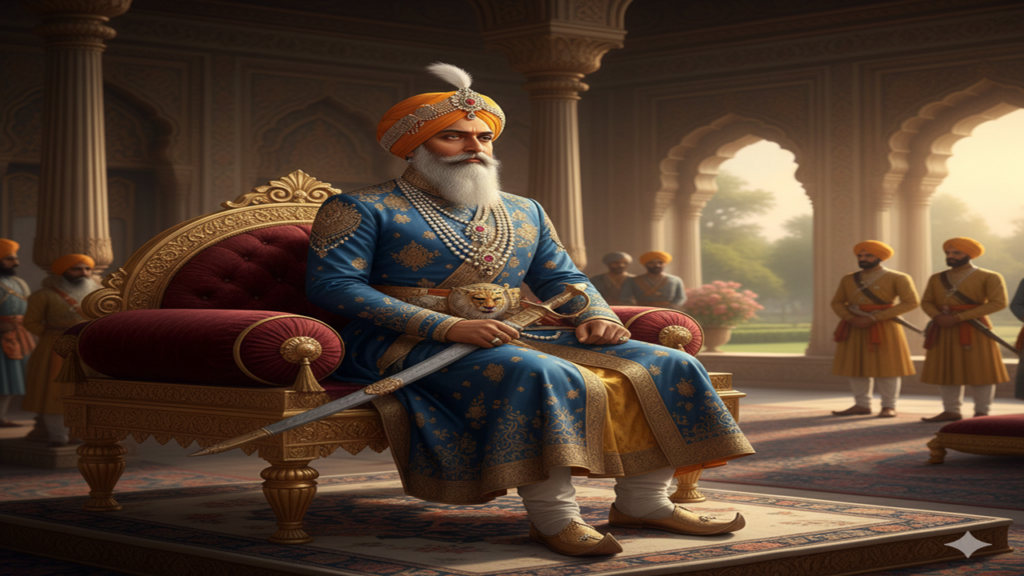
Sikh warriors later organized themselves into a confederacy known as the Dal Khalsa, which was eventually divided into twelve misls, each led by a chief or sardar. After the death of Aurangzeb in 1707, the power of the Mughal Empire declined rapidly, allowing these Sikh misls to establish control over different territories in Punjab.
Maharaja Ranjit Singh was born in 1780. Although he lost the sight of one eye due to illness in childhood, he displayed remarkable leadership abilities. He gradually united the various Sikh misls and captured Lahore in 1799. In 1801, he crowned himself Maharaja of Punjab and founded the Sikh Empire.
Ranjit Singh was a brilliant military leader who reorganized his army on European lines, employing several European officers to modernize the Sikh forces. After the decline of the Mughal Empire, Afghan rulers repeatedly invaded India through Punjab. One of Ranjit Singh’s greatest achievements was ending Afghan dominance in the region. What neither the Mughals nor the Marathas had fully achieved was accomplished by Ranjit Singh. He defeated the Afghans and brought important territories such as Kashmir, Multan, and Peshawar under his control. In the Battle of Nowshera, the Afghan forces were decisively defeated by Ranjit Singh and his general Hari Singh Nalwa.
Another significant achievement of Ranjit Singh was recovering the famous Koh-i-Noor from the Afghans. The diamond had originally been taken from the Mughal treasury by Nader Shah during his invasion of Delhi in 1739. Later, it came into the possession of Shah Shuja Durrani, who had been dethroned by his brother and had lost control of Kabul and Kandahar. Seeking Ranjit Singh’s help to regain his throne, Shah Shuja agreed to hand over the Koh-i-Noor in return for military assistance. Ranjit Singh obtained the diamond, though his wish to donate it to the Jagannath Temple remained unfulfilled.
Maharaja Ranjit Singh died in 1839, leaving behind a powerful and well-organized Sikh Empire.