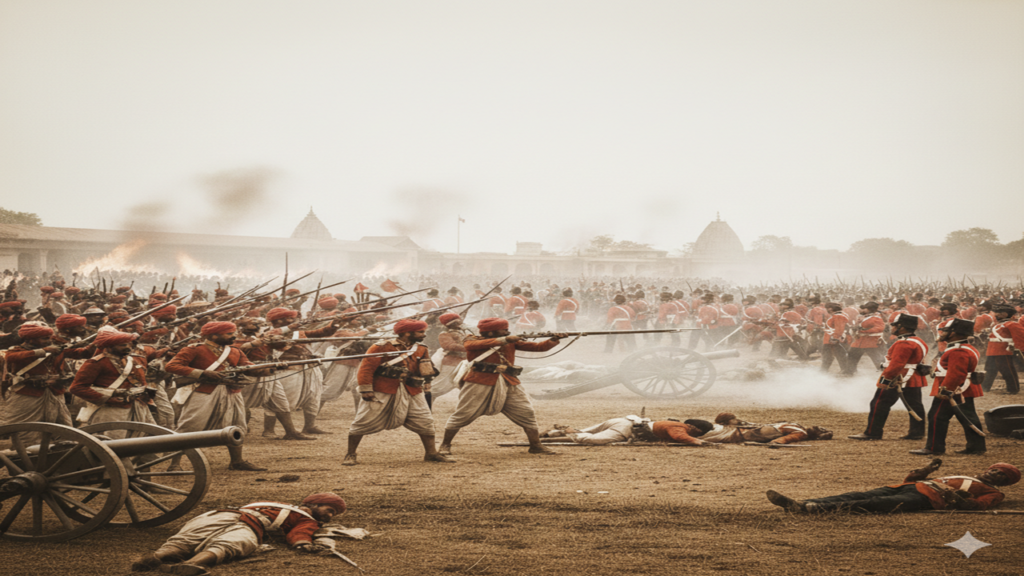
The Mughal Empire had no fixed or settled law of succession. After the death of an emperor—and sometimes even during his lifetime—potential heirs fought among themselves for the throne. Ultimately, the prince who emerged victorious became the emperor.
Shah Jahan was particularly ruthless in securing his claim to the throne. To eliminate rivals, he ordered the execution of several male members of the imperial family, including his brothers and their sons.
Khusrau Mirza, the elder brother of Shah Jahan, had earlier rebelled against his father Jahangir. As punishment, Jahangir had Khusrau blinded and kept in captivity. Shah Jahan, seeking to remove a potential rival, managed to obtain custody of Khusrau and had him killed while Jahangir was still alive. Jahangir was reportedly informed that Khusrau had died due to illness. It is also suspected that Shah Jahan may have arranged the poisoning of another brother, Parvez Mirza, in order to strengthen his claim to the throne.
At the time of Jahangir’s death in 1627, several potential claimants to the Mughal throne remained alive. These included Shah Jahan’s younger brother Shahryar Mirza, three sons of Khusrau, and two sons of Daniyal Mirza, who had been Jahangir’s brother.
Nur Jahan, the influential consort of Jahangir, supported Shahryar, who had married her daughter from an earlier marriage. In contrast, her brother Asaf Khan supported Shah Jahan, who was his son-in-law. At the time of Jahangir’s death, Shah Jahan was in the Deccan.
Shahryar, who was the governor of Lahore, quickly proclaimed himself emperor. To safeguard Shah Jahan’s interests, Asaf Khan acted swiftly. As a strategic move, he released Dawar Bakhsh from prison and temporarily proclaimed him emperor in order to counter Shahryar and buy time for Shah Jahan’s return.
Shahryar was soon defeated, blinded, and imprisoned in the Lahore Fort. Nur Jahan was placed under house arrest. Meanwhile, Asaf Khan sent urgent messages to Shah Jahan to return quickly from the Deccan.
After Shah Jahan reached the north, he was crowned emperor at Agra in 1628. Soon after his accession, Shah Jahan ordered Asaf Khan to eliminate all remaining male claimants to the throne. Acting on these orders, Asaf Khan arranged the execution of Shahryar, the three sons of Khusrau, and the sons of Daniyal during January and February 1628, thereby removing all possible rivals to Shah Jahan’s rule.