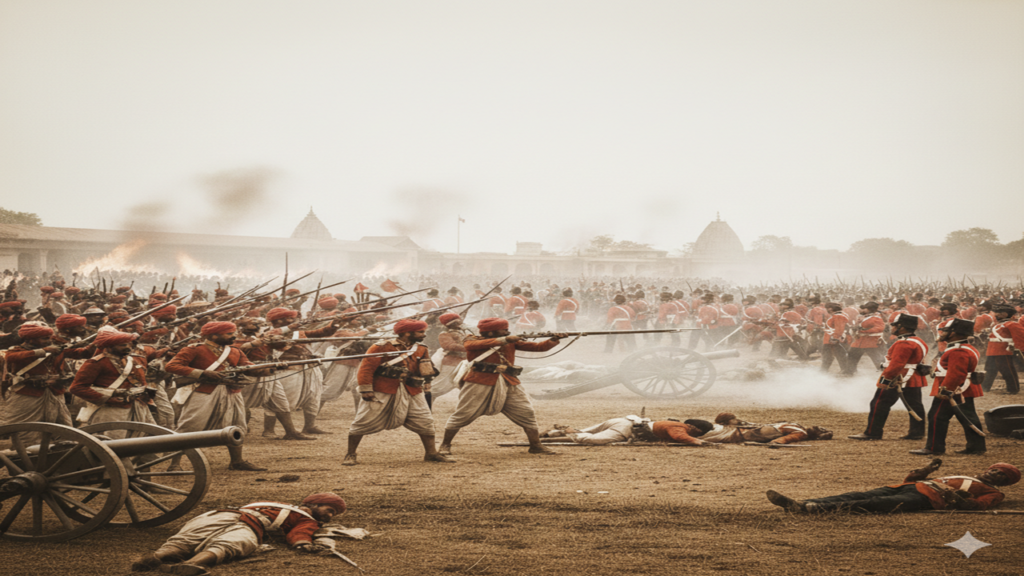
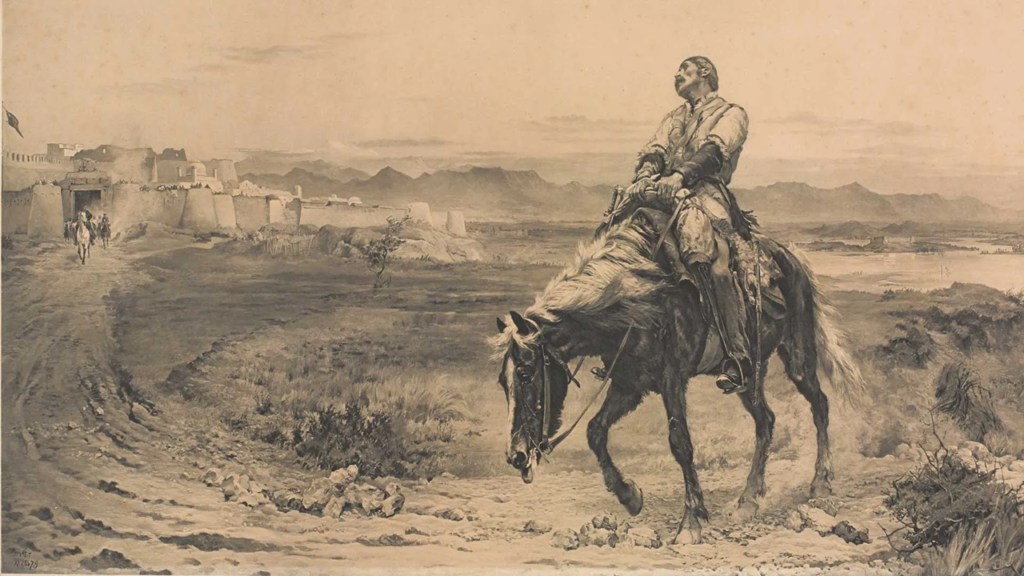
The East India Company had employed a huge number of Indian sepoys in its army. In 1857, the Company introduced the Enfield rifle in India. When Indian sepoys came to know that the cartridges used in this rifle were greased with cow and pig fat, their religious sentiments were deeply hurt. The Indian sepoys resisted, but the East India Company forced them to use the cartridges.
Mangal Pandey was the first to revolt at Barrackpore near Calcutta. On 29 March 1857, he attacked British officers and attempted to incite other Indian soldiers. He was court-martialed and executed on 8 April 1857 in front of several Indian sepoys.
The news of Mangal Pandey’s execution spread like wildfire among Indian sepoys and reached Meerut. The East India Company had created a huge military base at Meerut. Eighty-five soldiers at Meerut refused to use the cartridges. They were court-martialed and sentenced to ten years of imprisonment on 9 May 1857.
The Indian soldiers revolted on 10 May 1857. Several British soldiers were killed, and bungalows occupied by British officers were burned. The jail was broken, and the 85 imprisoned soldiers were released. The rebels marched to Delhi. Although Delhi was no longer a political power centre, it had great symbolic importance. They captured Delhi on 11 May 1857 and declared Bahadur Shah Zafar as the Emperor of India. British soldiers in Delhi were unprepared to fight the rebels, and the city came wholly under rebel control.
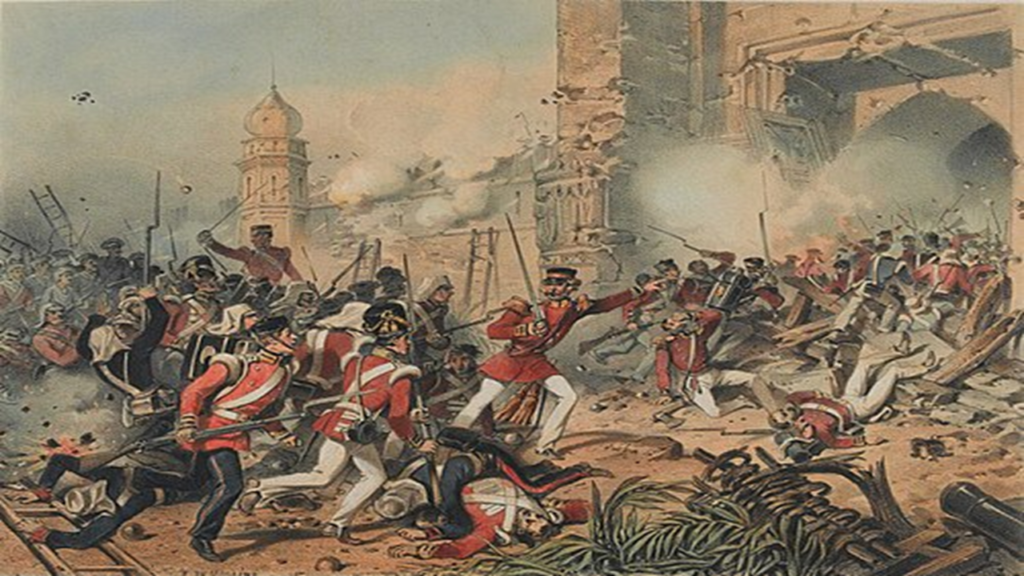
The British began making a strategy to recapture Delhi under General Nicholson. Till August 1857, Delhi remained under the control of the revolutionaries. Nicholson marched from Punjab and laid siege to Delhi, which was a fortified city, in September 1857. He succeeded in recapturing Delhi but was wounded in the process and later died. Thousands of Indians were killed after the recapture of Delhi.
Bahadur Shah Zafar fled to Humayun’s Tomb, from where he was captured by Major Hudson. The next day, Hudson again visited Humayun’s Tomb and captured three sons of Bahadur Shah Zafar. When they reached Khooni Darwaza, a crowd gathered there. Hudson killed all three princes in front of the crowd. Bahadur Shah Zafar was exiled to Rangoon. Thus, the East India Company, which had once begged for a license to trade from the Mughals and camped at the Mughal court, killed the sons of the Mughal emperor, exiled Bahadur Shah Zafar, and put an end to the Mughal Empire.