Babur inherited the throne of Fergana at a young age and aspired to rule over Samarkand. He was initially successful in capturing Samarkand, but in 1501 he was defeated by the Uzbek ruler Shaybani Khan. After this defeat, Babur wandered as a fugitive for several years.
In 1504, he moved eastward and managed to take control of Kabul. From there, he began to think of expanding towards India. At that time, the Delhi Sultanate was in decline and was ruled by Ibrahim Lodi.
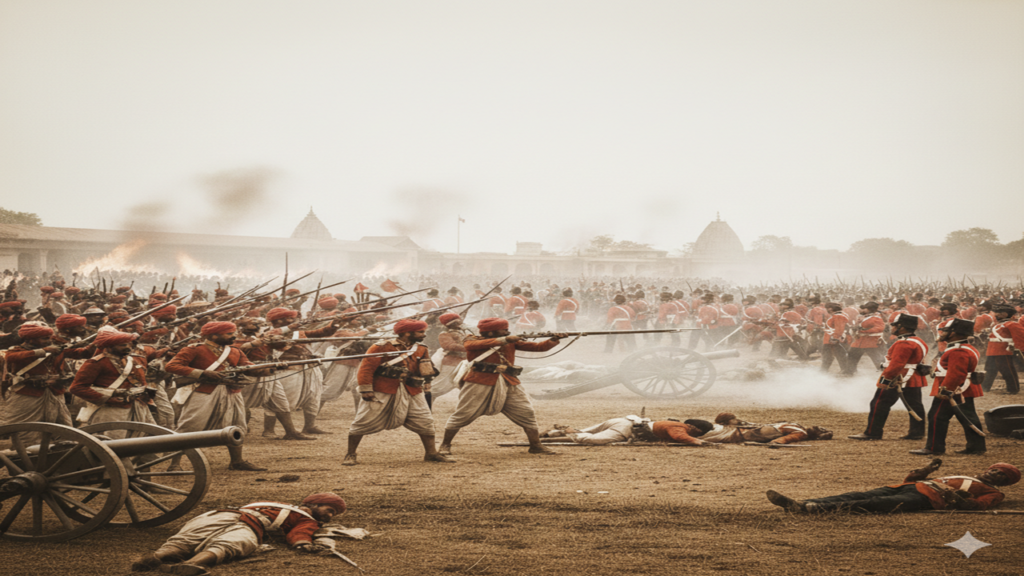
In November 1525, Babur marched towards Punjab. Daulat Khan Lodi, the Governor of Punjab, surrendered to him, and thus Babur gained control over Punjab. Thereafter, he advanced towards Delhi. In the First Battle of Panipat (1526), Babur defeated the much larger army of Ibrahim Lodi. After this victory, he took control of Delhi, Agra, and Gwalior.
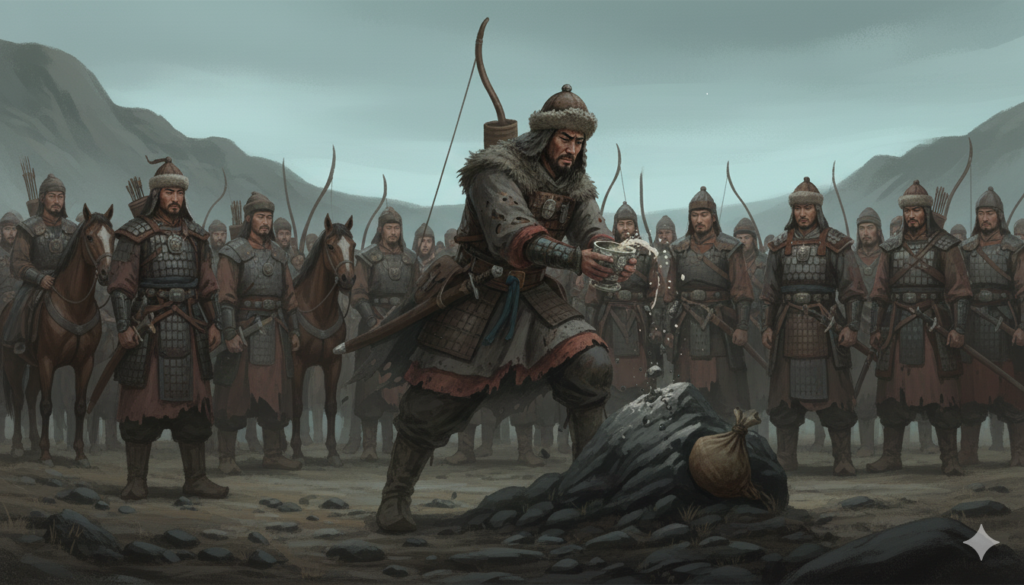
The next major challenge to Babur was Rana Sanga, the powerful Rajput ruler of Mewar (Chittor), who was much stronger than Ibrahim Lodi. Many of Babur’s soldiers wanted to return to Kabul instead of fighting Rana Sanga. To boost their morale, Babur declared the war a jihad and promised to renounce drinking after victory. He made every soldier swear on the Quran that they would not turn their backs on the battlefield. In the Battle of Khanwa (1527), Babur emerged victorious after fierce fighting. After the battle, he erected towers of skulls, a Mongol tradition. However, despite his victory, Babur did not attack Chittor and instead retreated.
In 1528, Babur defeated the Rajput king Medini Rai in the Battle of Chanderi and captured the fort. Medini Rai organised Jauhar, in which women and children immolated themselves to avoid capture.
After the defeat of Ibrahim Lodi, his brother Mahmud Lodi fled eastward and formed a coalition of Afghan chiefs to reclaim Delhi. He also received support from Nusrat Shah of Bengal. Babur marched eastward and defeated this coalition in the Battle of Ghaghra (1529).
Within four years of his invasion, Babur had conquered most of North India and thus founded the Mughal Empire. His victories are attributed to his use of cannons and muskets, as well as his superior military skills and strategies.