Portugal was enjoying a monopoly in the spice trade and making huge profits from it in the 16th century. Other European countries did not want to be left behind. Several merchants in London came together and formed the East India Company in 1600 AD, and obtained a royal charter from Queen Elizabeth I. However, it was not easy to trade with India because there was tough competition from the Portuguese and the Dutch East India Company, which had been formed in 1602.
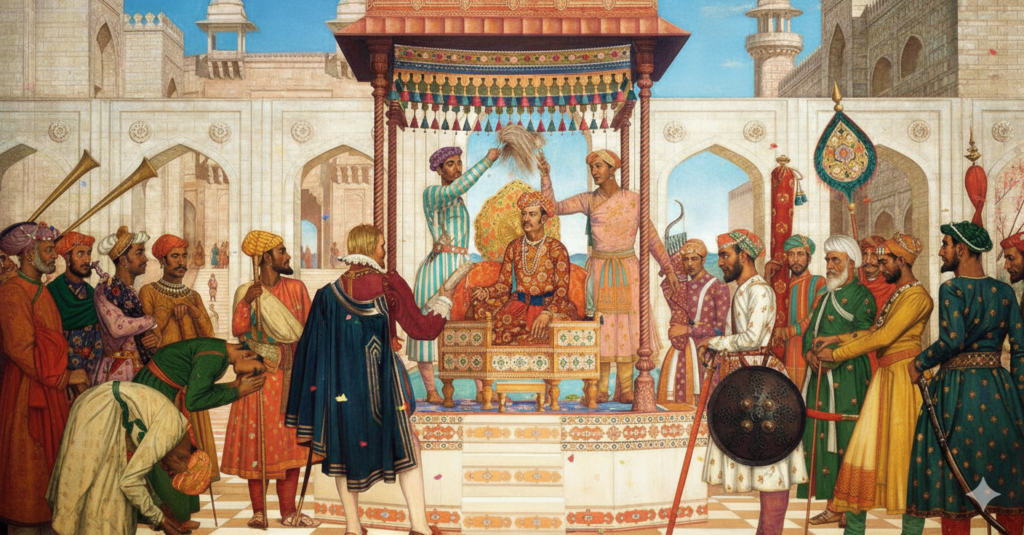
The East India Company knew that it could not survive in India without the protection of the mighty Mughals. The first ship of the Company reached Surat in 1608 under Captain William Hawkins on the ship Hector. Hawkins visited the court of Emperor Jahangir at Agra in 1609. He was well received by Jahangir and stayed at the Mughal court from 1609 to 1611, enjoying royal hospitality. However, due to strong Portuguese influence, he could not secure any significant trade privileges.
The Company continued its efforts. The British King James I sent Sir Thomas Roe as an ambassador to Jahangir in 1615. Roe presented Jahangir with fine wines, a carriage, and several European gifts, which pleased the emperor. Jahangir granted permission to the East India Company to establish factories at Surat and other places and to trade freely at Mughal ports.
The East India Company established factories at Masulipatam in 1611 and Madras in 1639, where Fort St. George was built. In 1651, with Mughal permission, the Company established a factory at Hooghly in Bengal. In 1661, England received Bombay as dowry from Portugal when Charles II married Catherine of Braganza, and later the King leased Bombay to the East India Company.
The East India Company sought more concessions from the Mughals in Bengal. Between 1686 and 1690, it came into direct confrontation with the Mughal Empire. The Company captured a Mughal ship near Hooghly and attacked Chittagong. In response, Aurangzeb ordered the eviction of the English from Surat, Masulipatam, Visakhapatnam, and Bengal. Realizing their mistake, the English paid heavy fines and sought pardon from Aurangzeb. In 1690, the Company established a factory at Sutanuti, which later developed into Calcutta (Kolkata). Later, Fort William was built there.
After Aurangzeb’s death in 1707, the Mughal Empire weakened and regional powers emerged. In 1717, the Company received important privileges from Emperor Farrukhsiyar through a farman. The farman granted the Company the right to trade in Bengal without paying customs duty, giving it a huge advantage over Indian merchants. While Indian merchants had to pay customs duty, the East India Company did not. The Company could also move goods freely within the Mughal Empire using dastaks (passes).
These privileges laid the foundation of British power in Bengal, the richest region of India at that time. In the future, these concessions became major causes of conflict between the Nawabs of Bengal and the East India Company.