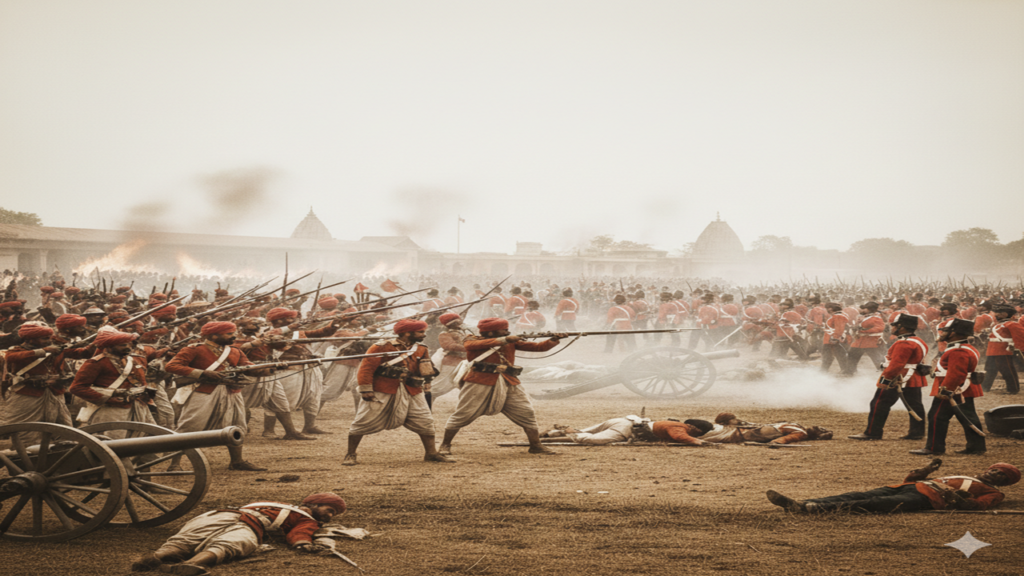
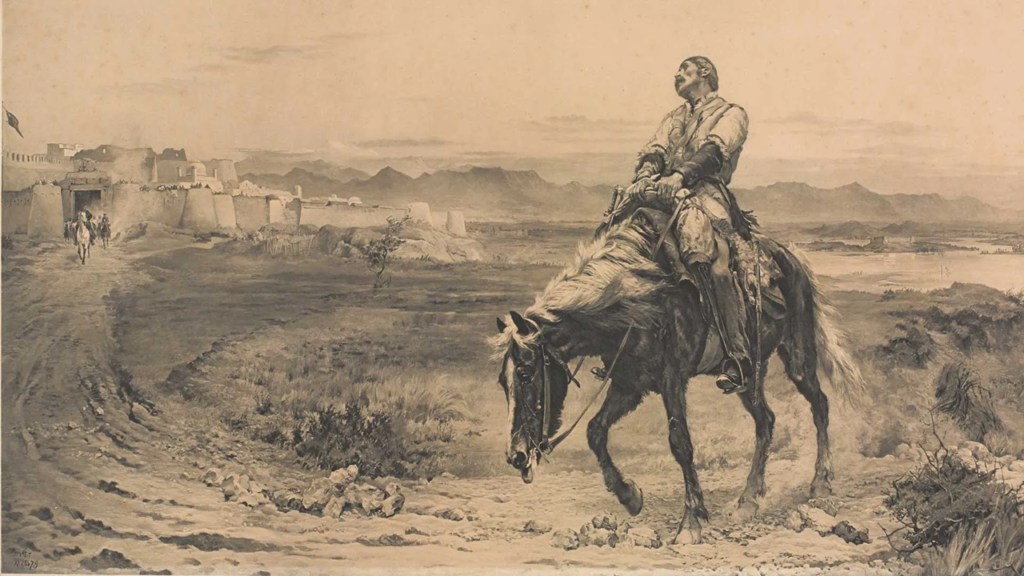
If the East India Company emerged as a kingmaker in Bengal after the Battle of Plassey (1757), it became the king itself after the Battle of Buxar (1764). After the Battle of Plassey, Mir Jafar was made the Nawab of Bengal, and the plunder of Bengal began. The East India Company was paid a huge sum of around 2.5 million pounds, which is estimated to be about ₹3,000 crore in today’s value. Robert Clive personally received a massive fortune and a jagir. He became one of the wealthiest men in England, with a personal wealth of about 500,000 pounds, estimated to be more than ₹800 crore today.
However, the demands of the East India Company kept increasing, and it was no longer satisfied with mere trade profits. Mir Jafar was unable to meet these demands and was replaced by Mir Kasim in 1760.
Mir Kasim tried to assert his independence after becoming the Nawab. He was unhappy with the misuse of dastak, a duty-free pass originally granted by the Mughal Emperor Farrukhsiyar. While Company officials did not pay customs duties, Indian merchants had to pay taxes. Company officials misused dastak for private trade and even sold it to Indian merchants. To counter this, Mir Kasim abolished duties for Indian merchants and refused to pay a share of Bengal’s revenue to the Company.
Mir Kasim shifted his capital from Murshidabad to Monghyr, where British presence was weaker. This led to conflict with the Company. Mir Kasim was defeated and fled. He then formed an alliance with Shuja-ud-Daula of Awadh and the Mughal Emperor Shah Alam II.
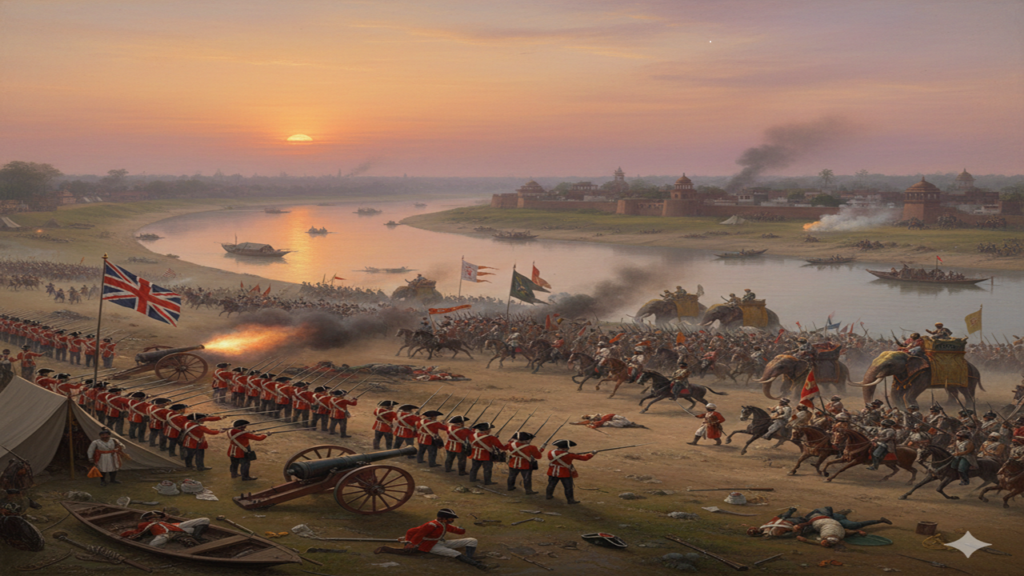
In the Battle of Buxar (1764), the East India Company, under Hector Munro, defeated the combined forces of Mir Kasim, Shuja-ud-Daula, and Shah Alam II. The Treaty of Allahabad (1765) was signed, by which the Company received Diwani rights of Bengal, Bihar, and Orissa, while the Nawab retained nominal administrative authority. This system is known as Dyarchy, which continued until 1772.
During this period, Bengal witnessed unprecedented plunder. The East India Company collected land revenue but sent most of it to England instead of spending it on administration. Land revenue was increased to nearly 50% of agricultural produce. The Company established a monopoly over trade, and Company officials earned huge profits through private trade. Farmers were forced to grow commercial crops such as opium and indigo instead of food crops. While the plunder of Bengal helped finance the Industrial Revolution in England, it resulted in the Great Bengal Famine of 1770, in which about one-third of the population died.
In 1772, Warren Hastings abolished the Dyarchy system. Thereafter, both revenue collection and general administration came directly under the control of the East India Company.