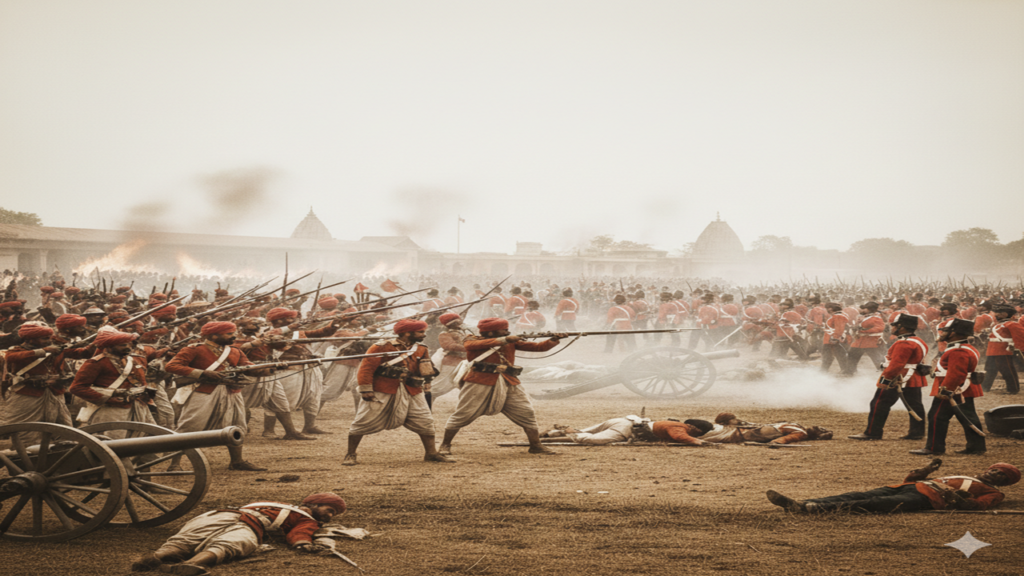
There are many figures in history who rose from humble beginnings to greatness, and one of the most remarkable among them was Shivaji. Born as the son of a jagirdar in the Bijapur Sultanate, Shivaji rose from modest circumstances to challenge the mighty Mughal emperor Aurangzeb. He founded the Maratha Empire, which later surpassed the Mughal Empire in power during the eighteenth century and extended its influence from Attock to Cuttack.
Shivaji was the son of Shahaji Bhonsle and was born in 1630. Shahaji served as a jagirdar under the Bijapur Sultanate, and Shivaji inherited the jagir of Pune from his father. Shivaji soon took control of several forts in the Pune region. He was not only an exceptional warrior but also a brilliant strategist and diplomat. Shivaji successfully used guerrilla warfare tactics, which allowed him to defeat stronger enemies. Gradually, he stopped paying revenue to Bijapur and established an independent kingdom.
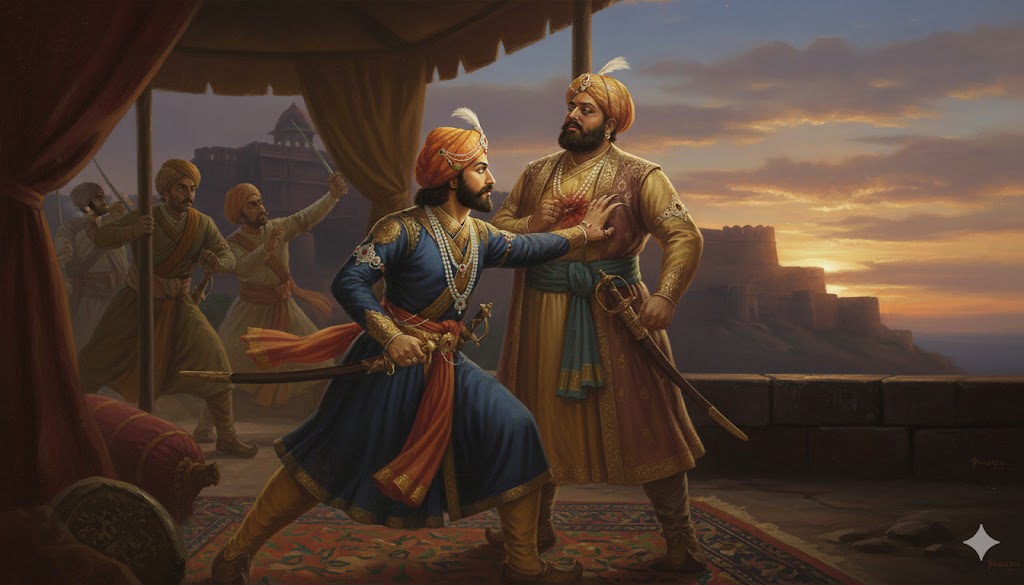
The ruler of Bijapur, Ali Adil Shah II, sent a powerful general, Afzal Khan, to subdue Shivaji. Afzal Khan was a formidable warrior and launched a campaign against Shivaji, even destroying the temple of the goddess Bhavani at Tuljapur. Realizing that it would be difficult to capture Shivaji in the mountainous terrain, Afzal Khan invited him to a private meeting under the pretext of negotiating peace. Afzal Khan secretly planned to assassinate Shivaji with a concealed dagger. Shivaji, however, anticipated treachery and wore protective armour while carrying concealed tiger claws (wagh nakh). When Afzal Khan attempted to stab him, Shivaji counterattacked and killed Afzal Khan using the tiger claws.
Soon, a confrontation with the Mughals became inevitable. Aurangzeb sent his uncle Shaista Khan with a large army of about 100,000 soldiers to suppress Shivaji. Shivaji initially retreated to the mountains and avoided direct confrontation for nearly three years. Shaista Khan occupied Shivaji’s residence, the Lal Mahal, and lived there comfortably. Shivaji then devised a daring plan. Gathering intelligence, he learned that musicians frequently entered the Mughal camp in the evening. Disguising his men, Shivaji and a small group of selected warriors infiltrated Pune through different gates and launched a surprise night attack on Lal Mahal. Several Mughal soldiers were killed, and Shivaji personally attacked Shaista Khan, cutting off several of his fingers. Shaista Khan survived but his prestige was severely damaged, and he was later transferred to Bengal.
Aurangzeb then sent another experienced commander, Raja Jai Singh I. The conflict ended with the Treaty of Purandar. Under this treaty, Shivaji agreed to serve the Mughal Empire and later visited Agra. However, he felt insulted when he was not given a high mansab and was placed under house arrest. Shivaji famously escaped from captivity and returned to the Deccan.
After his escape, Shivaji quickly recaptured the forts he had earlier surrendered. He expanded his influence into regions of present-day Karnataka and Tamil Nadu. He also again attacked and plundered the wealthy Mughal port city of Surat.
In 1674, Shivaji crowned himself as an independent Hindu sovereign. The coronation ceremony was conducted by the scholar Gaga Bhatt, who had been invited from Varanasi. Shivaji continued expanding his kingdom in southern India until his death in 1680 at the age of fifty, leaving behind a strong and independent state that later evolved into the powerful Maratha Empire.