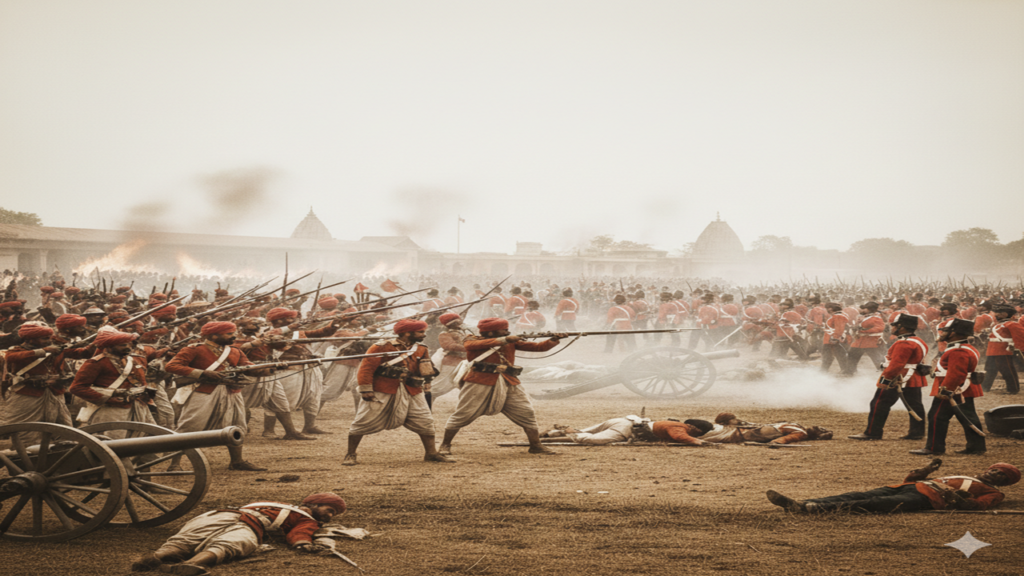
Awadh was originally under the control of the Mughal Empire. In 1722, Saadat Khan was appointed as the governor of Awadh. After the death of Aurangzeb, the Mughal Empire began to decline, and Awadh gradually became autonomous. The position of the Nawab became hereditary.
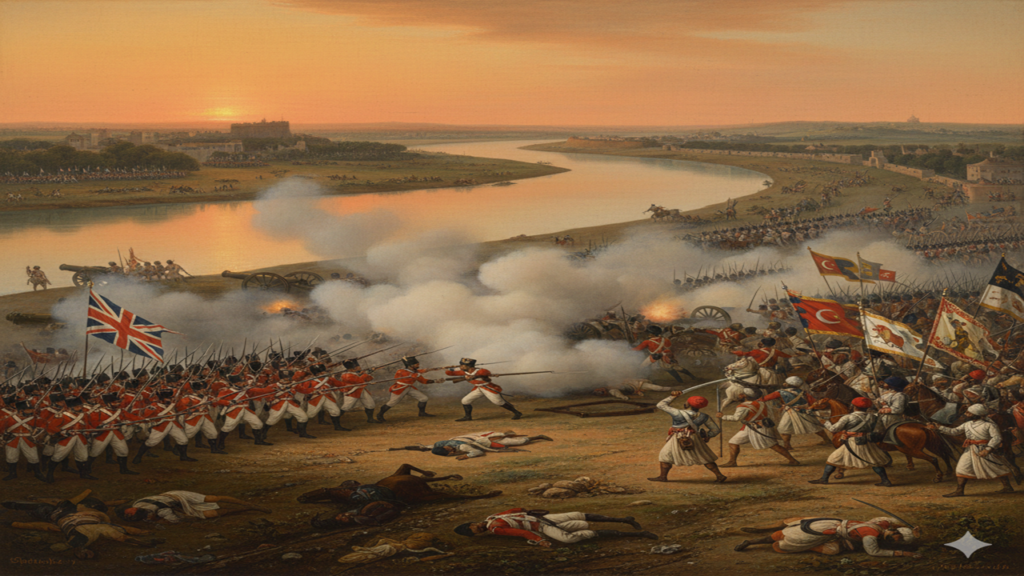
In 1764, the combined forces of Awadh, Mughal Emperor Shah Alam II, and Mir Qasim were defeated by the East India Company in the Battle of Buxar. After this defeat, the Treaty of Allahabad (1765) was signed, under which Awadh was forced to pay a huge indemnity to the Company. Although Awadh was not annexed directly, it was compelled to maintain British forces in the name of protection. A British Resident was appointed in Awadh, and the state had to bear the cost of the British troops. Thus, Awadh lost a significant degree of its independence.
The independence of Awadh was further weakened in 1801, when it entered into a Subsidiary Alliance with the British. Awadh had to cede nearly half of its territory to pay for military expenses. The Nawab was prohibited from maintaining an independent army and lost control over foreign relations. Consequently, Awadh became a dependent princely state under British influence.
Finally, in 1856, Awadh was annexed by the British on the ground of alleged misgovernance. Wajid Ali Shah, who became Nawab in 1847, was the last Nawab of Awadh and ruled from Lucknow. He was a patron of Urdu poetry, music, painting, and dance, and was himself a composer. After the annexation, he was exiled to Kolkata.
The decline of Awadh has been vividly depicted in “Shatranj ke Khiladi” by Munshi Premchand, where the nobility is portrayed as indulging only in pleasure and luxury. A famous film titled Shatranj ke Khiladi was also made based on this story.