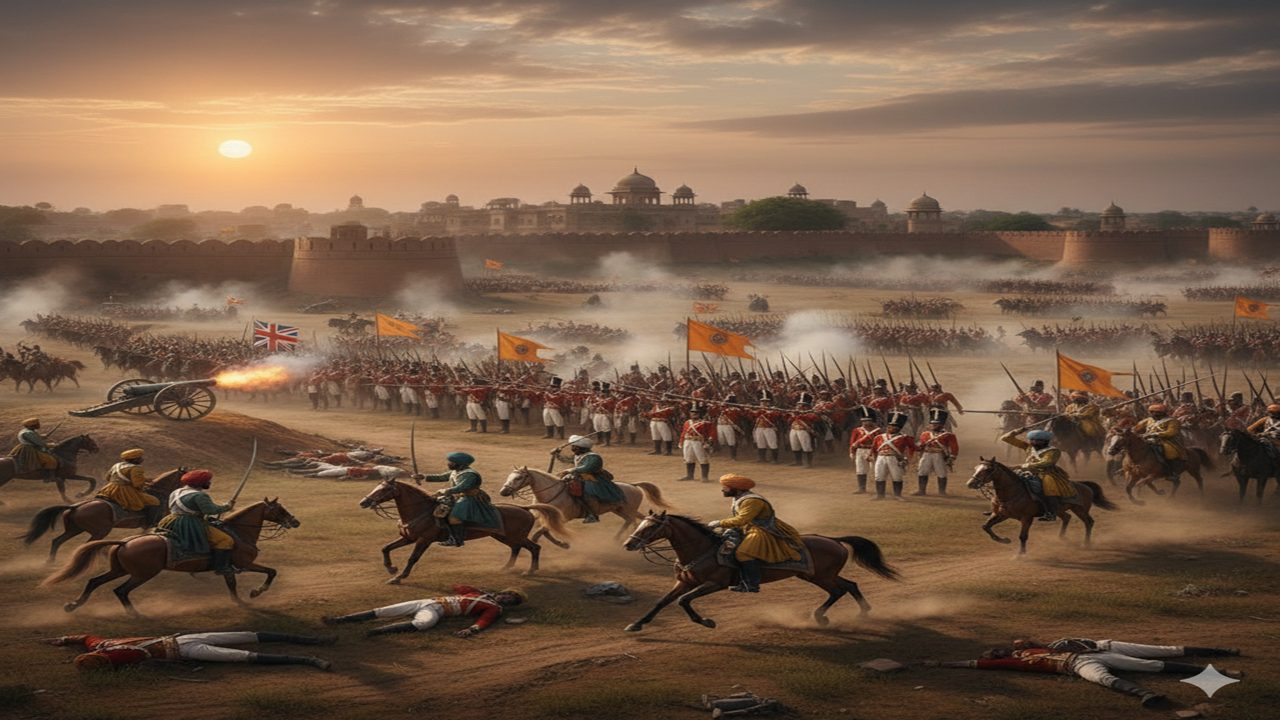
After the decline of the Mughals, the Marathas emerged as the most powerful kingdom, controlling much of central India. They even collected Chauth from the Nizam and the Mughals and rajputs. They confronted Ahmad Shah Abdali in the Third Battle of Panipat; although they were defeated, they later recovered. The mighty Marathas fell because of their own internal strife rather than strength of the East India Company.
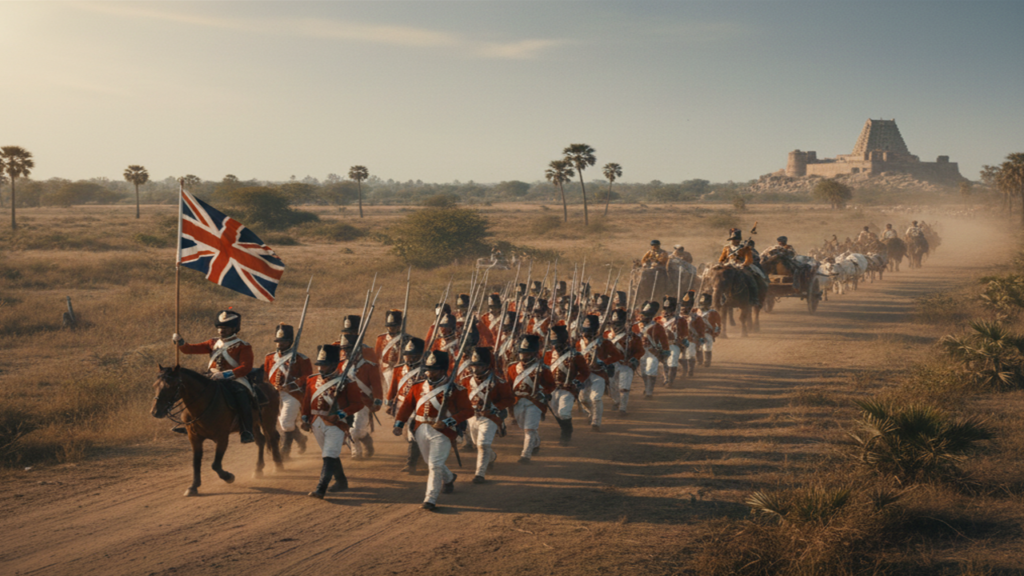
Power had gradually shifted from the successors of Shivaji to the Peshwas, and then from the Peshwas to several chieftains. The Peshwa ruled at Pune, the Scindhia at Gwalior, the Holkar at Indore, Bhonsle at Nagpur and the Gaekwad at Baroda. Over time, the control of the Peshwa weakened.
The Peshwa himself provided an opportunity for the East India Company to interfere in Maratha affairs, which led to the First Anglo-Maratha War (1775–1782). Peshwa Madhav Rao I died in 1772 and was succeeded by his brother, Peshwa Narayan Rao, who was murdered. His uncle claimed the position of Peshwa, but the infant son of Narayan Rao, Madhav Rao II, was eventually made Peshwa.
Raghunath Rao approached the East India Company for help and signed the Treaty of Surat, ceding Salsette and Bassein to the Company. This triggered war between the Company and the Marathas. The East India Company was defeated by the Marathas at the Battle of Wadgaon (1779). Eventually, the Treaty of Salbai recognized Madhav Rao II as Peshwa and restored peace.
Internal Maratha conflicts again allowed the East India Company to interfere in 1802. By this time, the Company had consolidated its power in South India: Mysore had been defeated, the Nizam had entered into a subsidiary alliance.
A conflict arose between the Peshwa and the Holkars when Peshwa Baji Rao II favored the Scindhias. The Peshwa executed the brother of Yashwant Rao Holkar, prompting Holkar to invade Poona and defeat the combined forces of the Peshwa and Scindhia in the Battle of Poona (1802). Peshwa Baji Rao II fled and signed the Treaty of Bassein (1802), entering into a subsidiary alliance with the British. This angered Scindhia and Bhonsle and led to the Second Anglo-Maratha War (1803–1805).
Several battles were fought during this war. General Wellesley advanced from the Madras Presidency and defeated the combined forces of Scindhia and Bhonsle at the Battles of Assaye and Argaon, capturing the Gwalior fort. General Gerard Lake advanced from the Bengal Presidency, capturing Aligarh, Delhi, and Agra.
Marathas were forced to sign several treaties and cede several areas to East India Company. The Marathas ceded huge territories, including Delhi, Agra, parts of Gujarat, Bundelkhand, and parts of Orissa. British forces were stationed in Poona, further increasing interference in Maratha affairs.
After the Second Anglo-Maratha War, the East India Company continued to expand its influence. In 1817, the Treaty of Poona further reduced the Peshwa’s authority, leading to the erosion of his sovereignty.
At the same time, the menace of the Pindaris—irregular mercenaries formerly attached to the Mughal and Maratha armies—was increasing. Without employment, they engaged in looting and plundering. The East India Company accused the Marathas of supporting them and intervened in Maratha territories, leading to the Third Anglo-Maratha War (1817–1818).The Peshwa attacked the British Residency but was defeated. Gwalior and Baroda remained neutral, having already accepted British supremacy. Holkar was defeated at the Battle of Mahidpur and signed the Treaty of Mandsaur, becoming a protected state. Bhonsle was defeated at Sitabuldi and also became a protected state. The Peshwaship was abolished, and the Peshwa’s territories came under direct British administration.The Peshwa was pensioned at Bithur near Kanpur, and the Pindaris were suppressed.
Thus, after the Third Anglo-Maratha War, the last standing empire in India collapsed and the most of India came under the control of the East India Company.