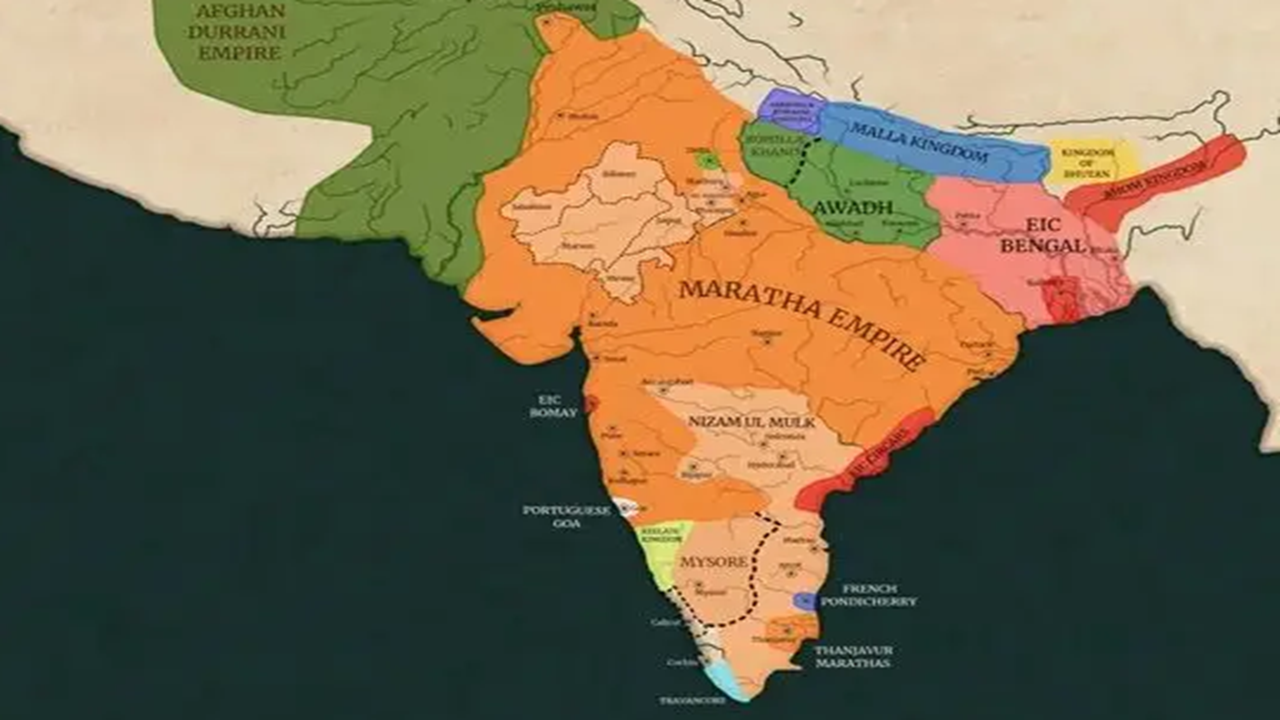
After the death of Aurangzeb in 1707, the decline of the Mughal Empire began. Gradually, the political vacuum was filled by the rising Maratha power. The Maratha Empire, founded by Shivaji, emerged in the 18th century as the most powerful political force in India. At its height, it extended from Attock in the northwest to Cuttack in the east.
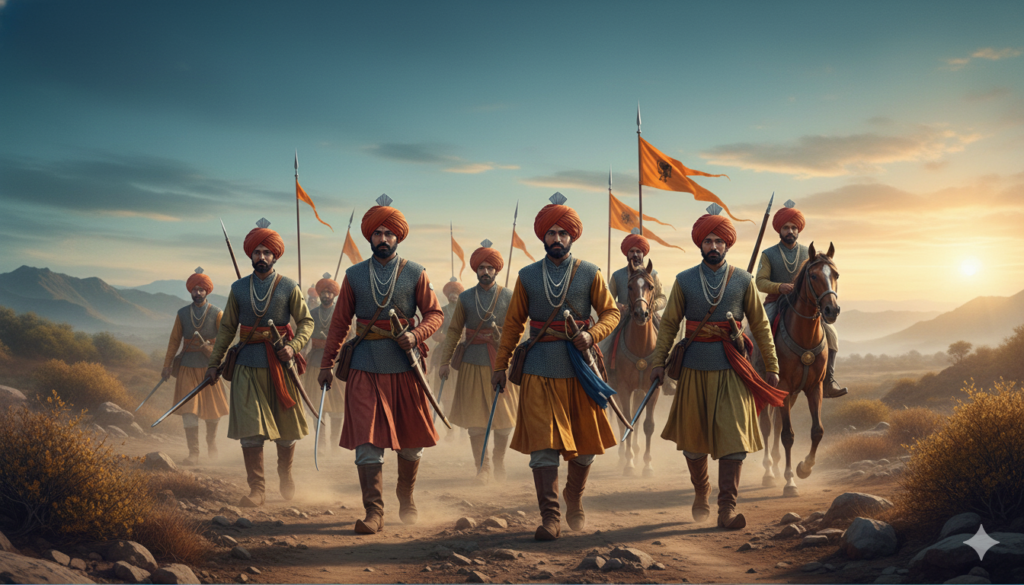
Shivaji crowned himself Chhatrapati in 1674 and laid the foundation of a strong and independent Maratha state. At the time of his death in 1680, he controlled significant territories in present-day Maharashtra, Karnataka, and parts of Tamil Nadu. He was succeeded by his son Sambhaji.
Aurangzeb continued his campaign to suppress the Marathas, and Sambhaji was eventually captured and executed by the Mughals. After him, Rajaram I became Chhatrapati and continued the struggle against the Mughals, but he died at a young age. His widow, Tarabai, ruled on behalf of her minor son Shivaji II and carried forward the resistance with remarkable determination.
After Aurangzeb’s death, Shahu I, who had been held captive by the Mughals, was released. With the support of the Peshwa, he won the war of succession against Tarabai. During Shahu’s reign, real power gradually shifted to the Peshwa, who had originally been just one of the ministers in the Ashtapradhan council established by Shivaji. Over time, the Peshwa based at Pune became the actual centre of authority, while the Chhatrapati at Satara was reduced to a nominal figurehead.
Under the leadership of powerful Peshwas such as Baji Rao I, the Maratha Empire expanded rapidly and became the dominant power in India, surpassing the weakened Mughals. The Marathas extended their influence over Malwa, Gujarat, Orissa, and Hyderabad. They even advanced into the northwest, capturing Lahore and hoisting their flag there.
The Mughal emperors were compelled to accept a subordinate position. The Marathas entered into an arrangement to protect Delhi in return for revenue payments. However, when Ahmad Shah Durrani invaded India, the Mughals were incapable of defending the empire. The Marathas confronted him in the Third Battle of Panipat in 1761. After a fierce and bloody conflict, the Marathas were defeated. Though this was a severe setback, it did not completely destroy their power, and they gradually recovered.
Ultimately, it was internal rivalry rather than Panipat that led to the decline of Maratha supremacy. Power shifted from the Peshwa to powerful military chiefs—the Scindias, Holkars, Bhonsles, and Gaekwads—who began functioning almost as independent rulers. The absence of a strong central authority weakened the confederacy.
The British followed a policy of divide and rule, leading to a series of conflicts known as the Anglo-Maratha Wars. After the Third Anglo-Maratha War, the office of the Peshwa was abolished, and the Maratha Empire formally came to an end.