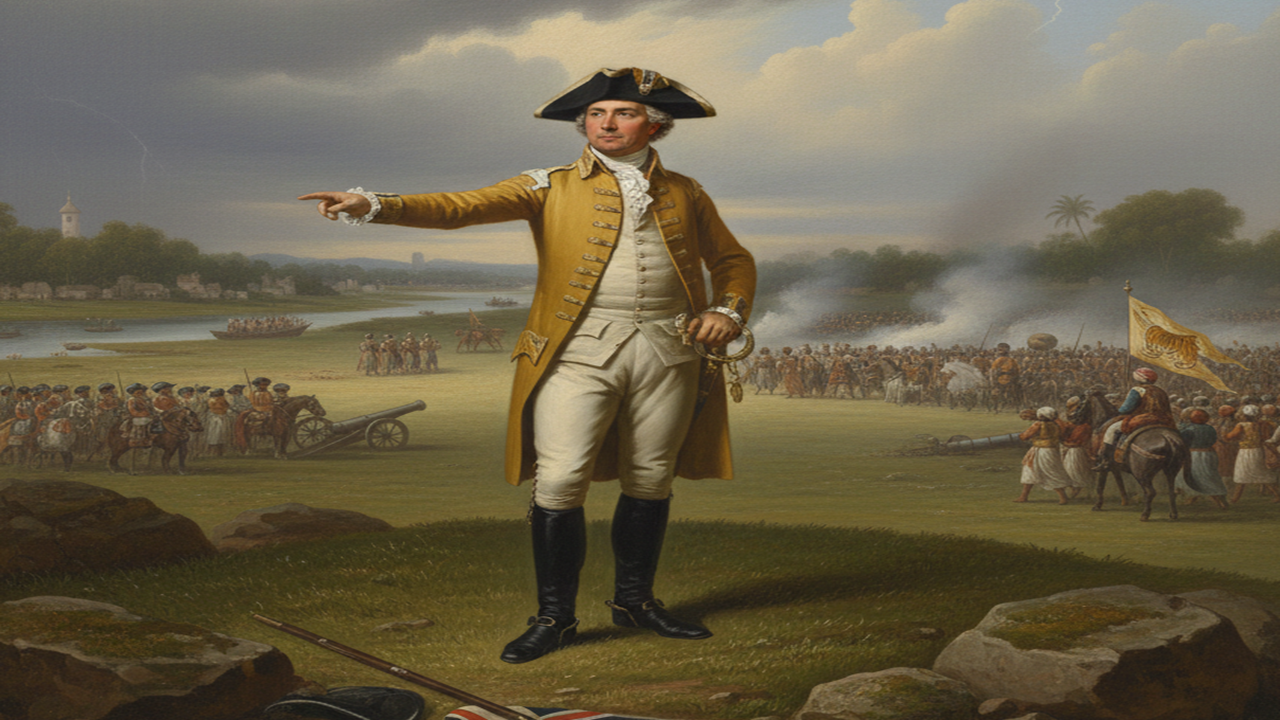
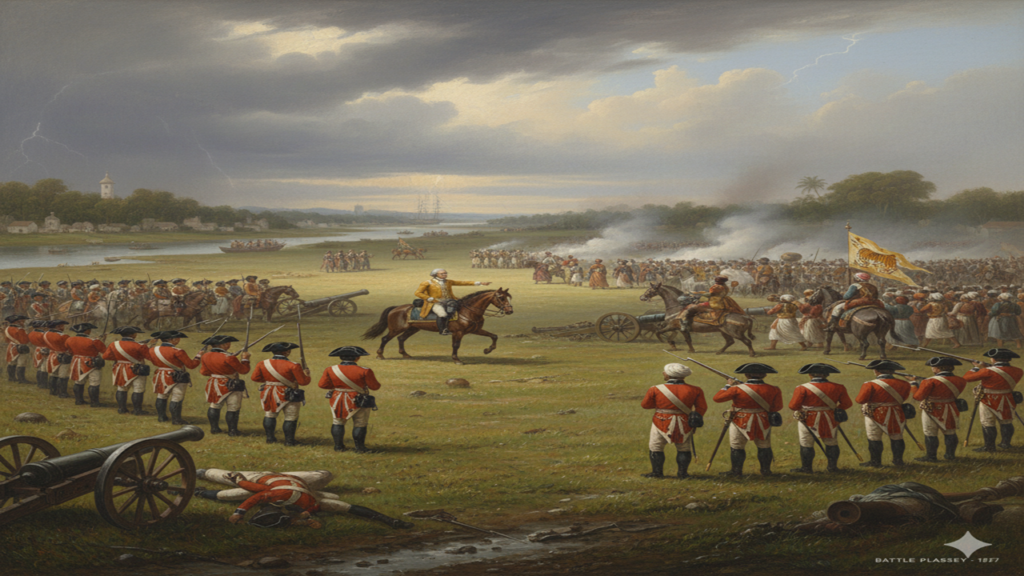
The Battle of Plassey in 1757 was an important battle that paved the way for British rule in India. The Second Battle of Tarain in 1192 paved the way for the establishment of the Delhi Sultanate, the First Battle of Panipat in 1526 facilitated the rise of the Mughal Empire, and the battle of palassey paved the way for British Rule in India. East India Company converted from mere trading company to a territorial power.
After the death of Aurangzeb, the Mughal Empire declined rapidly, and several regional powers emerged. Murshid Quli Khan, a converted Muslim, was appointed governor of Bengal by Emperor Farrukhsiyar in 1717 and given the title of Nawab. Gradually, the Nawabs of Bengal became effectively independent.
In 1756, Siraj-ud-Daulah inherited the Nawabship of Bengal, Bihar, and Orissa from Alivardi Khan at the age of 23. Several stakeholders were dissatisfied with his succession. He faced an immediate challenge from Shaukat Jung, the Nawab of Purnia, whose rebellion was repelled, and Shaukat Jung was killed.
Bengal was the richest at that time. The East India Company was willing to have more and more trade cocessions from Mughals. Several officials of the East India Company had camped at the court of Emperor Farrukhsiyar and even treated him from serious illnesses. These visits were successful, and Farrukhsiyar issued farmans granting the Company several trade concessions. The Company was granted dastaks, which were duty-free passes within Mughal territory. However, these were often misused for private trade by Company officials. Furthermore, the Company was fortifying Fort William without the permission of Siraj-ud-Daulah.
In 1756, Siraj-ud-Daulah attacked and captured Calcutta, renaming it Alinagar. During this seizure, around 146 prisoners were confined in a small room without ventilation, resulting in many deaths. This event became known as the Black Hole of Calcutta.
The British began conspiring against Siraj-ud-Daulah, successfully influencing Mir Jafar, Jagat Seth, and Omichand. Mir Jafar, commander of the Nawab’s army, aspired to become Nawab himself. Jagat Seth, a leading merchant, was unhappy with Siraj-ud-Daulah’s policies. Omichand, another wealthy merchant, also sought personal gain. The East India Company promised to make Mir Jafar the Nawab of Bengal in return for his support.
In 1757, Robert Clive marched toward Murshidabad. The armies of Siraj-ud-Daulah and Clive met at the village of Plassey. As planned, Mir Jafar did not participate in the battle. Siraj-ud-Daulah was defeated and fled, and Mir Jafar was installed as the puppet Nawab of Bengal under the East India Company. Siraj-ud-Daulah was later captured and executed.